
Cottage Food Safety: Rules, Training, and Best Practices for Home Producers
Cindy Ignis · March 3, 2025
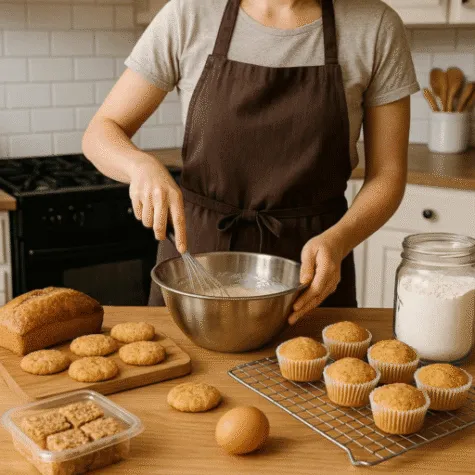
Starting a cottage food operation lets you turn a home kitchen into a real business: baked goods, jams, candies, and other shelf-stable foods, made at home and sold legally under your state's cottage food law. With that opportunity comes a responsibility the law only partly enforces for you. Cottage food rules are light on inspections by design, which means food safety rests almost entirely on the producer's own knowledge and habits.
This guide covers what legally counts as a cottage food operation, how these businesses are regulated, the food safety practices that matter most in a home kitchen, and the point at which a growing operation outgrows cottage food status.
What counts as a cottage food operation
A cottage food operation (CFO) is a home-based food business permitted under state law to produce and sell specific low-risk foods: typically foods that do not require refrigeration or time and temperature control for safety¹. Common examples:
- Baked goods without cream or custard fillings
- Jams, jellies, and preserves
- Dry mixes, spice blends, and granolas
- Candies and confections
- Certain shelf-stable snacks
Every state draws its own lines, and they vary widely: which foods are approved, where you can sell (some states allow farmers markets only, others permit online sales), annual sales caps, labeling rules, and whether training or registration is required. Your state's department of agriculture or health department is the authority; the NCSL cottage food law summary and Forrager's state-by-state directory are useful starting points.
How cottage food operations are regulated
Unlike commercial food manufacturing, cottage food oversight is mostly indirect. Many states never inspect a cottage food kitchen at all. Instead, the model relies on:
- Producer self-certification or registration
- Required (or encouraged) food safety training
- Complaint-driven investigations after a problem
That light touch is what makes cottage food businesses accessible, and it is also exactly why training matters more here than in an inspected facility: there is no inspector catching your mistakes before a customer does. Many states make the connection explicit by requiring cottage food producers to hold a food handler card. Even where it is optional, the course covers precisely the risks that home production runs into: hygiene, sanitation, cross-contamination, and allergens. Our food handler course is ANAB-accredited, takes about 75 minutes, and costs $8.
The food safety practices that matter most at home
The FDA Food Code provides the science-based foundation², and four areas do most of the work for a cottage producer:
Personal hygiene. Wash hands for at least 20 seconds with soap and warm water before handling food, after the restroom, and after any interruption that could contaminate hands². And do not produce food while experiencing vomiting, diarrhea, jaundice, or with infected wounds: in a one-person operation, honest self-assessment replaces the supervisor you are required to report to in a restaurant³.
Temperature awareness. Cottage foods are shelf-stable by definition, but their ingredients often are not. Eggs, dairy, and fresh fruit pass through the danger zone (41°F to 135°F, where bacteria multiply fastest²) during preparation, and cooling steps in recipes need to move food through that range quickly.
Cross-contamination control. The home-kitchen problem is that production and family life share equipment. Use separate boards and utensils for different ingredient types, store raw ingredients where they cannot drip onto anything, and clean and sanitize between tasks². Our cross-contamination guide covers the full system.
Sanitation. The Food Code's cleaning sequence is clean (remove soil with detergent), rinse, then sanitize with an approved sanitizer at proper concentration, such as chlorine solution at 50–100 ppm². Cleanliness you can see is not the same as sanitized.
Allergens and labeling: the highest-stakes part
Allergen mislabeling is among the most common and most dangerous cottage food failures, because trace amounts can cause life-threatening reactions and home kitchens are full of cross-contact opportunities.
Federal law now recognizes nine major allergens: milk, eggs, fish, shellfish, tree nuts, peanuts, wheat, soybeans, and sesame⁵. Most states require cottage food labels to include the product name, a full ingredient list in descending order by weight, a declaration of major allergens, the producer's name and contact information, and a statement that the product was made in a home kitchen.
Practical allergen control at home:
- Keep detailed ingredient records for every product and batch
- Separate allergen and non-allergen production in time, not just space: allergen-free items first, full cleaning after
- Store allergenic ingredients sealed and apart
- Use dedicated utensils where possible
- Treat the label as a safety device, not packaging. See our food allergen guide for the full picture
Thinking in systems: HACCP for a home kitchen
Full HACCP programs are not required for cottage operations, but the underlying discipline scales down well⁴: identify what could go wrong with your specific products (hazard analysis), find the points where you can control it (pH for acidified foods, bake temperatures and times, cooling), set limits, and write down what you did.
That last step is the one most cottage producers skip. Basic records (ingredient lots, production dates and batches, cleaning schedules, any customer complaints) are what let you handle a problem like a professional: a targeted recall of one batch instead of everything you have ever sold, and evidence of diligence if a complaint ever brings the health department to your door.
The three gaps that catch cottage producers
- The kitchen itself. Home kitchens share equipment between family and business, rarely have dedicated storage, and run on household cleaning rhythms. None of that is disqualifying; all of it demands deliberate separation and scheduling that commercial kitchens get from their layout.
- Informal everything. No written recipes, no ingredient specs, no records. Fine until the first complaint, at which point you can demonstrate nothing.
- Scaling without upgrading. Success is the quiet risk: production volume grows, controls stay hobby-sized, and exposure compounds without anyone deciding to accept it.
When you outgrow cottage food status
Every state's cottage food law has ceilings: product types, sales channels, revenue caps. Crossing them means transitioning to a licensed commercial operation, with routine inspections, broader product freedom, and full regulatory compliance including preventive controls⁶.
The best preparation for that transition is running your cottage operation as if the inspector already visits: training current, records kept, processes written. Producers who build those habits early find the step up to commercial operation an upgrade in paperwork, not a change in character.
The bottom line
Cottage food laws trust producers with public health in exchange for low barriers to entry. The producers who thrive under that bargain treat food safety as the foundation of the business rather than a hurdle: trained, documented, realistic about risk, and ready to grow. Start with the food handler course, keep your records, and read your state's law once a year: it changes more often than you would think.
Sources
- U.S. Food and Drug Administration. Cottage Food Operations. https://www.fda.gov/food/buy-store-serve-safe-food/cottage-food-operations
- U.S. Food and Drug Administration. FDA Food Code. https://www.fda.gov/food/retail-food-protection/fda-food-code
- U.S. Food and Drug Administration. Employee Health and Personal Hygiene Handbook. https://www.fda.gov/food/retail-food-protection/employee-health-and-personal-hygiene-handbook
- U.S. Food and Drug Administration. Hazard Analysis Critical Control Point (HACCP). https://www.fda.gov/food/guidance-regulation-food-and-dietary-supplements/hazard-analysis-critical-control-point-haccp
- U.S. Food and Drug Administration. Food Allergies (including FASTER Act / sesame). https://www.fda.gov/food/food-labeling-nutrition/food-allergies
- U.S. Food and Drug Administration. FSMA. https://www.fda.gov/food/food-safety-modernization-act-fsma
- National Conference of State Legislatures. Cottage Food Laws. https://www.ncsl.org/health/cottage-food-laws
- Forrager. State Cottage Food Law Summaries. https://forrager.com/laws/