
Power outage in a restaurant: what to keep, what to toss, and when to close
Daniel Follett
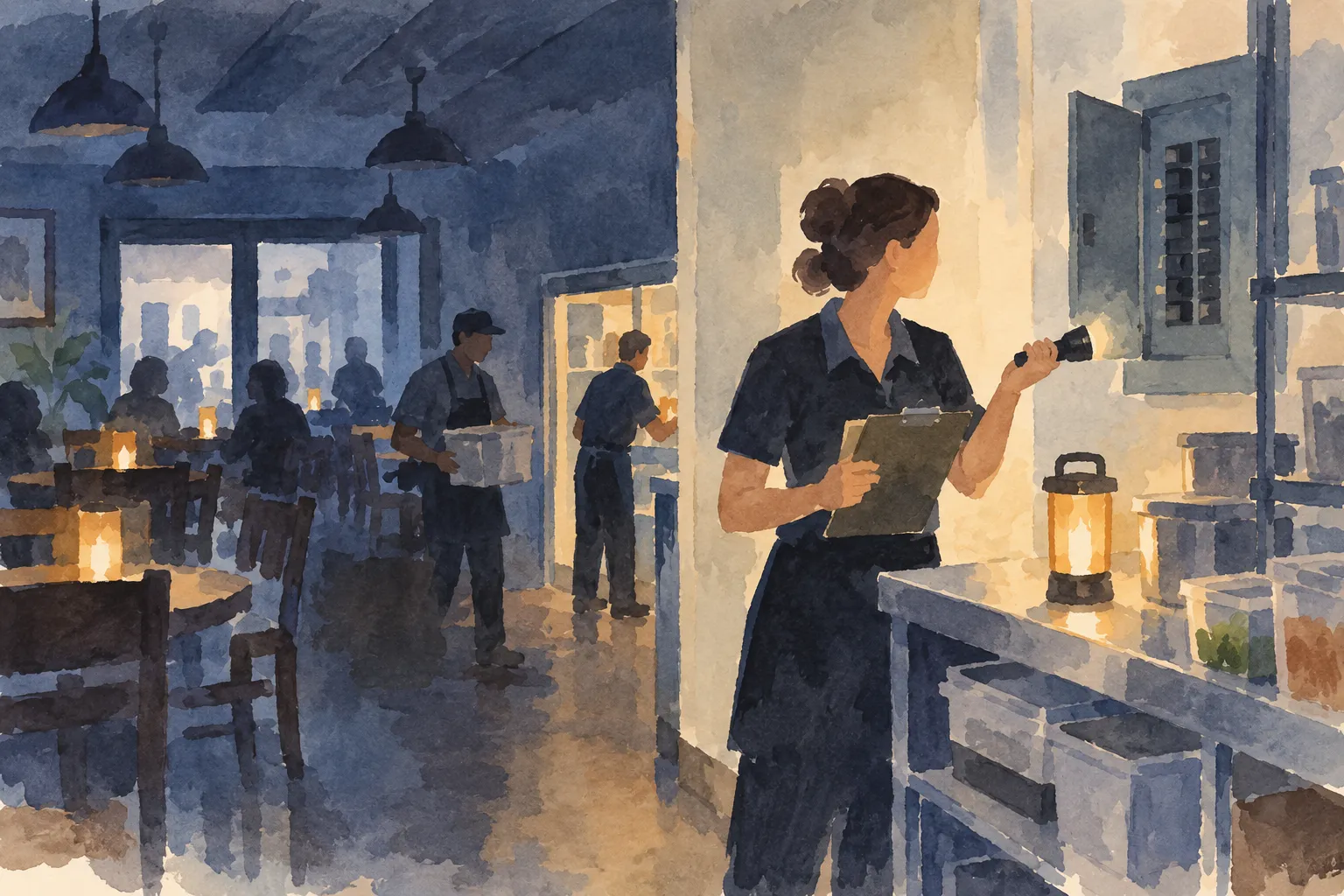
A kitchen goes dark in the middle of dinner service, or the walk-in is warm when the opening manager arrives after a storm. An extended loss of power is one of the emergencies the Food Code names. What happens to the food, and whether the restaurant can stay open, depends on decisions made in the first minutes and on whether anyone is writing down temperatures. This article covers what the rules require, what the guidance allows, and what a manager should have on paper before storm season.
What the Food Code requires
The FDA Food Code, which most state and local health codes are built on, addresses power loss directly. Section 8-404.11 says a permit holder "shall immediately discontinue operations and notify the regulatory authority if an imminent health hazard may exist because of an emergency such as a fire, flood, extended interruption of electrical or water service, sewage backup," or a similar event. An imminent health hazard is a significant threat to health that requires immediate correction or a stop to operations. While this might seem pretty open-and-shut, there are a couple of important caveats. First, operations need only stop in the parts of the establishment the hazard affects. Second, the regulatory authority can agree to let an establishment keep operating through an extended outage if a written emergency operating plan was approved in advance, immediate corrective action is being taken, and the authority is told when the plan goes into effect.
Section 8-404.12 addresses the reopening: if operations were discontinued, the permit holder must obtain approval from the regulatory authority before resuming. A restaurant that closes for an outage does not reopen on its own when the lights come back.
Temperature rules do not change during an emergency. Time/temperature control for safety (TCS) food must be held at 41°F or below, or at 135°F or above. When time alone is used as the control, the Food Code allows a maximum of four hours, with written procedures and food marked with its discard time.
The first ten minutes
Note the date and time the power went out, then start taking and recording food and equipment temperatures, and keep doing so on a set schedule. The Conference for Food Protection's Emergency Action Plan for Retail Food Establishments, developed with FDA participation and adopted at its 2012 and 2014 meetings, is the standard reference for the rest of this article, and it is clear on one point: if temperatures were not monitored during the outage and the food may have exceeded 41°F, the food should be discarded.
Keep every refrigerator, freezer, and walk-in door closed, and tape signs on them so staff do not forget. Open display cases and small reach-ins lose cold fastest; cover them with insulated covers, cardboard, or plastic, and move their product to a walk-in or a refrigerated truck if one is available. Do not put hot food into refrigeration equipment that has lost power. Call the utility and get an estimate of the duration, because a forty-minute outage and a two-day outage call for different responses.
Cold food: how long you have
Do not open the walk-in to check by hand. FDA's consumer guidance says a closed refrigerator keeps food safe for about four hours, a full freezer for about 48 hours, and a half-full freezer for about 24. Commercial equipment varies, which is why the record of actual temperatures matters more than any rule of thumb.
The Emergency Action Plan's Chart 1 gives operators a defensible way to decide disposition, and it is more generous than most managers expect, on one condition: the establishment has a written plan prepared in advance and has been recording temperatures according to it. The clock starts either when the power failed or when the food first reached 41°F, whichever method the plan specifies. The window then depends on how warm the food got:
- If TCS food never exceeded 45°F, it may be held, sold, or served for up to 15 hours. At 15 hours it must be back to 41°F or be cooked or discarded.
- If it never exceeded 50°F, the window is 9 hours.
- If it never exceeded 55°F, the window is 6 hours.
- If it reached 60°F, the window is 4 hours.
Food that stays inside its window is treated as if the deviation never happened; the use-by date does not change. Food that is still above 41°F when its window closes must be cooked immediately or thrown away. The chart is an emergency tool, written into a plan, and is not a license for day-to-day operations.
Frozen food follows a simpler test. Product that is still solid or semi-solid, with no weeping, staining, or package damage, can be refrozen. TCS food that has softened but has not exceeded 41°F on the outside and is still frozen at the core can be refrozen or cooked.
Hot food, cooking, and dishes
Hot-held food has less time. If power returns within two hours, reheat the food rapidly to 165°F within a further two hours; the time it spends between 41°F and 135°F should not exceed two hours in total. If power does not return within two hours, the food must be discarded within four hours of the outage, unless an alternate heat source such as canned heat is keeping it above 135°F with hourly temperature checks.
Cooking should stop unless the ventilation system is running on backup power, because there is no other way to remove smoke and grease-laden air, and any TCS food that was mid-cook or mid-reheat when the power failed and never reached its final temperature must be discarded. A three-compartment sink can carry warewashing if hot water is still available; otherwise switch to single-service tableware, and stop any operation that generates soiled utensils that cannot be washed and sanitized. If the sewage ejector pumps are down, operations stop.
Generators help, but they rarely cover refrigeration by default. Have a licensed electrician size and connect them, plan for refueling on a long outage, and tell the utility you are running one so its crews are safe.
Reopening
When power returns, document the time. Confirm that refrigeration is back to 41°F or below, that hot holding, ventilation, water heaters, sewage pumps, warewashing, and handwashing sinks all work, and reset any tripped breakers. Food-contact surfaces, utensils, and equipment may need cleaning and sanitizing before use, and check ice machines, since melted ice pools inside them. Work through the disposition of every TCS item against the temperature log rather than by appearance; FDA's guidance for households applies in a kitchen as well: never taste food to judge whether it is safe. And if the establishment was required to close, wait for the regulatory authority's authorization to reopen.
Put it in writing now
Almost every allowance above comes with the same condition: a written plan, prepared in advance, kept on site, and available to the health department on request. In some jurisdictions the department will want to approve it beforehand, which is also the only route to staying open through an extended outage. The plan should name who calls the utility and who calls the health department, which coolers are monitored first and how often, where temperatures are logged, where product moves if a case cannot hold, and what sources of ice, dry ice, or refrigerated trucks are available when the whole neighborhood wants them too. Train the staff on it before storm season, and keep a printed copy on site; a plan stored only on a computer is unavailable during the emergency it was written for.
Sources
- FDA, Food Code 2022, sections 1-201.10, 3-501.14, 3-501.16, 3-501.19, 8-404.11, and 8-404.12
- Conference for Food Protection, Emergency Action Plan for Retail Food Establishments, Second Edition (2014)
- FDA, Food and Water Safety During Power Outages and Floods (updated March 5, 2024)