
Food handler card vs. food manager certification: which do you need?
FenixFoodSafety Team · May 21, 2025
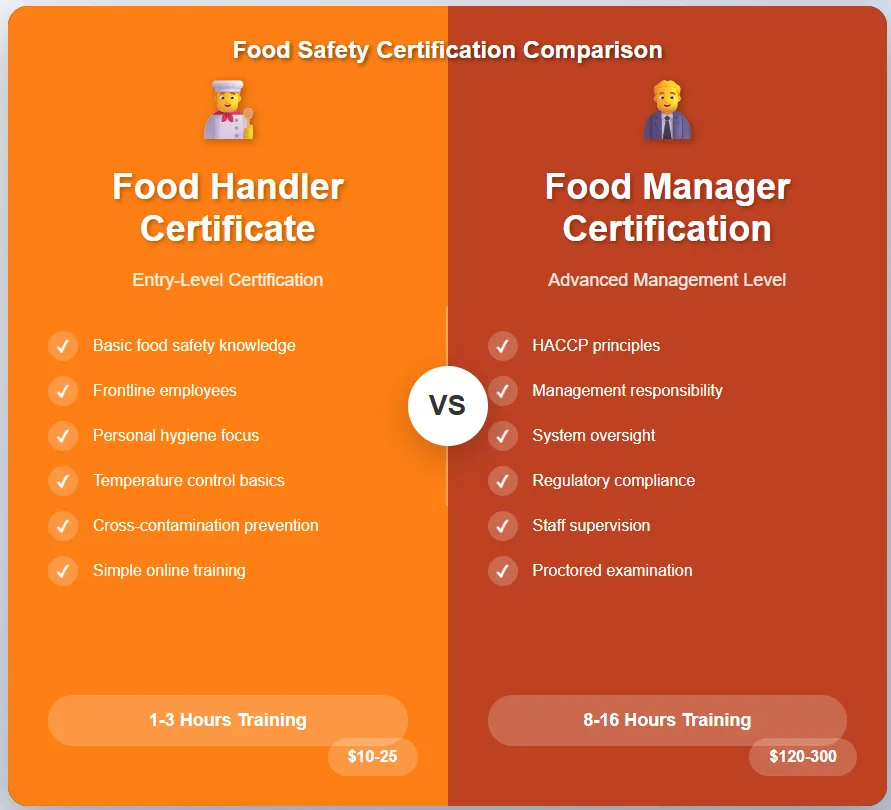
If you prepare, serve or store food, you probably need a food handler card, which is a short online course. If you run a shift, you probably need food manager certification, which means a longer course and a proctored exam. Most restaurants need both: at least one certified manager, and a food handler card for everyone else.
The rules come from your state and sometimes your county. The examples below quote the actual rules and link to them, so you can check them yourself.
The difference at a glance
Food handler card
- Who it's for: cooks, servers, bussers, dishwashers, baristas, and anyone else who handles food
- What it covers: handwashing, illness reporting, time and temperature control, cross-contamination, allergens and cleaning
- Time: about 1 to 2 hours online
- Test: a short test at the end of the course
- Accreditation: ANAB-accredited to the ASTM E2659 standard, where your state requires it
- Valid for: usually 2 or 3 years, depending on the state
- Cost: about $7 to $15
Food manager certification
Also called Certified Food Protection Manager, or CFPM.
- Who it's for: the person in charge, such as managers, shift leads, kitchen supervisors and owners
- What it covers: running a safe operation, including food safety systems, training and supervising staff, and inspections
- Time: a longer course, followed by the exam
- Test: a proctored exam, taken in person or online with a live proctor
- Accreditation: a program accredited under the Conference for Food Protection standard
- Valid for: usually 5 years
- Cost: often $100 or more for the course and proctored exam
Who needs a food handler card?
Anyone whose job involves preparing, storing or serving food. Whether the card is required by law depends on where you work.
- California requires a food handler card within 30 days of hire. It has to come from a provider accredited to the ASTM E2659 standard, and it stays valid for three years, even if you change jobs (Health and Safety Code §113948).
- Texas requires every food employee except the certified food protection manager to complete an accredited food handler course within 30 days of employment. The business must keep each employee's certificate on the premises (25 TAC §228.31). Texas food handler certificates are valid for two years.
- Some states leave the decision to counties or cities, and a few don't require a card at all. Employers often ask for one anyway.
Employers have a reason to ask. The FDA Food Code, which most states base their rules on, makes the person in charge responsible for making sure employees are "properly trained in food safety, including food allergy awareness, as it relates to their assigned duties" (FDA Food Code 2022, §2-103.11(O)).
To see what your state requires, use our food handler requirements map.
Who needs food manager certification?
The person responsible for food safety while the business is open.
- Under the FDA Food Code, the person in charge "shall be a certified food protection manager," certified through a program accredited under the Conference for Food Protection standard (§2-102.12 and §2-102.20). Very low-risk operations can be exempt. States adopt the Food Code on their own schedule, so your state's version may read differently.
- Texas requires a certified food protection manager to "be present at the food establishment during all hours of operation." Operations the health department considers minimal risk, such as those selling only prepackaged food, are exempt (25 TAC §228.31(b)–(c)).
- California requires "at least one food safety certified owner or employee at each food facility." New facilities and new owners have 60 days to comply, and certified managers must recertify every five years (Health and Safety Code §113947.1).
If some of your shifts run without a certified manager, you may need to certify more people. In Texas, the requirement covers every hour you're open.
Do managers need a food handler card too?
In Texas and California, no.
- Texas's food handler rule covers "all food employees, except for the certified food protection manager."
- California's law doesn't count someone with a valid manager certificate as a "food handler," so they don't need a separate card (Health and Safety Code §113790).
Other states may handle it differently, and some employers ask managers to hold both. Manager certification covers everything in a food handler course and more, so it's the better credential if you're moving into management.
How to tell whether a course counts
- Food handler: if your state requires accreditation, choose a course accredited by ANAB to ASTM E2659. You can look up any provider in ANAB's directory. Our food handler courses for Arizona, California, Georgia, Hawaii, Illinois, New Mexico, South Carolina, Texas and West Virginia are ANAB-accredited, and our Utah course is approved by the Utah Department of Health and Human Services.
- Food manager: choose an exam accredited under the Conference for Food Protection standard. Your health department can tell you which exams it accepts.
- Watch for "certificates" that meet neither standard, and for courses that charge extra to download or print your certificate.
A checklist for owners
- Make sure a certified food protection manager covers the hours your state requires. In Texas, that's every hour you're open.
- Have every other food employee get a food handler card by your state's deadline. It's 30 days in both Texas and California.
- Keep copies where an inspector can see them. Texas requires this for food handler certificates.
- Track expiration dates. Food handler cards usually last 2 or 3 years, and manager certifications about 5.
Buying training for a team? Team purchases include assignable seats and a manager dashboard.
Frequently asked questions
Is a food handler card the same as food manager certification?
No. A food handler card is a short course on the basics for frontline staff. Food manager certification is a longer course and a proctored exam for the person in charge.
Can food manager certification replace a food handler card?
In Texas and California, yes. Certified managers don't need a separate food handler card there. Check your own state's rules.
How long is each one valid?
Food handler cards usually last 2 or 3 years: three in California, two in Texas. Manager certification usually lasts five years, and California requires recertification every five.
Do you offer food manager certification?
Not yet. You can sign up to hear when it opens. Until then, your health department can tell you which accredited exams it accepts.
Get your food handler card
$8, about 75 minutes, and your certificate as soon as you pass. Choose your state.
Sources
- FDA Food Code 2022: §2-102.12, §2-102.20 and §2-103.11(O)
- Texas Food Establishment Rules, 25 TAC §228.31
- California Health and Safety Code §113790, §113947.1 and §113948
- ANAB certificate issuer directory